Friday, July 20, 2007

EXIT ONLY!

Where in the world does a body have to travel to find the Entrance to the Exit? If you see a sign that says "Exit, " should you leave or should you come on in??? The answer is to be found in Seward, Alaska. The name of one of the most popular Glaciers in the state is "EXIT." You can hike in to it- right up to the edge, in fact, and that's just what we did! The pathway to the lower edge of the glacier was flooded out. The path to the next level of the glacial edge was flooded as well. So we hiked up, maybe a 2.5 mile round trip, to the edge of the glacier at a higher vantage and lookout point. It wasn't exactly running up and down Mount Marathon like the last time we were here in Seward (just for the day with Gary and Judy) but for us old coots it WAS a hike. But what a view and what an experience!
Factoid: EXIT glacier has retreated by 50 feet a year. Global warming? Not hardly. Whether you think global warming is fact or fiction or somewhere in between- EXIT glacier has been retreating by 50 feet per year- FOR THE LAST 200 YEARS! That's long before anyone claims that man's carbon footprint was doing damage to our environment. While I find the topic a fascinating one, the evidence never seems to be quite as overwhelming in one direction or the other as some would have us believe. But this is about a travelogue, not a science paper, so the discussion goes on....
Hiking in...and up...
getting closer...Hey, Titanic, look out, icebergs ahead!
Whoa, what a big one that is....

Click on pic below to see the people in front of the glacial edge to put the whole thing in perspective...
You want the science of the glacier, enlarge and read here below....

Sign of the Day

In no other state in the union will you see this sign! 'Nuff said....

Wednesday, July 18, 2007

Flowers of Hope and Resurrection

I simply cannot think of a more profound way to express our thanks to Gary and Judy Skaggs of Anchorage, Alaska for sharing their friendship, their time, their energy, their expertise, their knowledge and their love of this state with us, then to share with you some of the pictures I took of the wildflowers at the camp in Hope.
It always seems to be the case that some of the most extreme beauty the world has to offer springs forth from the most extreme and adverse conditions on the planet. Winters here are down right harsh and they are long as well. Summer has but a short window to prove its worth and celebrate its very being. So in the village of Hope and by the River of Resurrection, these little reminders grow back each year in loving memory of those who endured, even prospered and thrived here. Of those who lived a life here or only a brief moment. Of those who came to share the experience of the place and were made better for doing so. Of those whose time was cut short . Of those who are interred for eternity here in the wind and the land and the water of life.
For sharing your special place with us, thank you from the bottom of our hearts....


Hope and Resurrection

Twenty miles outside Anchorage as the crow flies and almost 90 as the bus drives is the village of Hope. This is, though little known and even lesser publicized, the actual location of the first gold find in Alaska. Both lode and placer operations existed outside the sleepy and quaint little village for many years, and in fact, Hope Mining Company still holds, maintains, operates, buys and sells mining leases to this day. This post will introduce you to some of the players in the company, but you can get a lot more information by using the link provided to their web site.
In the photo that follows, Gary and Judy, our friends from Anchorage, who actively operated a claim on the Hope Mining property for thirteen years before reducing their exposure to the day to day operations to a more relaxed use of the claim as camp and a place to share good times and activities with friends, took us for our first ATV (scooter) ride ever- from the gold claim camp to the village of Hope. Here we sit on the edge of both the village and the Turnagain Arm. If you go there looking for beauty, adventure, and even gold - I can pretty much guarantee you will find all of the above. Gary and Judy are shareholders in the mining company.
We had a scooter of our own to use on each of the two four day weekends they shared their camp with us. Before I actually used one, I never really understood the thrill that they seem to garner among enthusiasts of the vehicles. But now I do! They have the amazing capability to carry you nearly anywhere you would care to go in the outdoors. You could do the same thing hiking, but you'd never be able to see so much in a limited amount of time, and besides, it's much easier to ride across those little streams and keep your feet dry than it is to wade in and come out soaking wet and cold. They are also marvelous as mini tractors. We used them to haul our mining equipment, our water, and even our fishing poles when we ventured out for the day. The rush of the wind in your face is akin to the thrill of the motorcycle, but it's more for an off road adventure AND it has four wheels which makes staying upright a whole lot easier.
In the next photo behind Marilyn, and the real reason I included the photo, is a pile of "tailings." Tailings are what's left after the mining operation has extracted the gold from the ground. Basically, it is a pile of rocks. The ones in this photo, like most of the ones up near Fairbanks and also in many other parts of the state, were left behind after the water canons were used to wash away the overburden and the smaller gravel that contained the gold. While many of the techniques used to recover gold are similar to those used in the old days of mining, the equipment and the technologies have improved- at least in part- and have become more efficient. This is why today we can re-work the tailings piles and still find enough gold to keep things interesting. Of course I should not fail to point out one simple truth. The gold pan- the choice of miners old and new alike- is still the single most efficient and effective tool in the recovery of gold. How you get the dirt for panning? That's where things have changed a bit with time.
There's more than mining to the Hope Mining Property Claims land! They have some guest accommodations that will take you back to the olden days. Literally. Here's the Honeymoon Log Cabin. Yes! It's for real.
Al Johnson, President of Hope Mining, set up a highbanker for us to try. The highbanker is a sluice box with a twist. It can be used on the actual site where the material is being mined rather than having to lug the material to the stream to use the sluice there. It does this by the use of a pump which brings the water to the equipment. It can wash any size gravel or rock that fits into the hopper, and it moves far more volume of dirt than does panning or manual sluicing. Basic process: dirt and rock in the hopper up top, large tailing out the back, small tailings out the front, water out everywhere but mainly down the sluice shoot and out the front; as for the gold- it's supposed to stay in the sluice box- and yes it does!
Meet Bob, Jackie, and pal Charley. Friends of Gary and Judy they shared time and camp with us at the Hope Claim. Here they try out our little sluice box, which seemed to work very well for them. Charley and Abby became good friends. It was great for the dogs to get a chance to be off the leashes and play a bit, and certainly there's no better place to do it.
This artsy shot is of the rubber mat, the first stage of the sluice box, with water flowing over it at a pretty good clip. The mat comes first, the several sets of "rips" that create eddies for the heavier-than-other-materials gold to settle out in. The bottom of the box is covered with a rough indoor-outdoor like carpet and a metal wire grid that also serves to trap the gold. If you didn't know better, you would think that the gold would wash right through the box and out the other end. But it doesn't. In fact it is so much heavier than the other material being fed into the sluice that it drops out and onto the mat almost the second it hits the flowing water. Once it sticks to the mat or the carpet behind the rips, it will stay there all day while you feed in more and more material. It won't come out until the process is complete and you "clean up" for the day by panning or picking depending on the size of the gold recovered. Click on the photo to enlarge and you will be able to see the small "flakes" of gold on the mat.
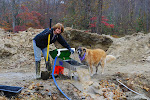
Meanwhile back at the stream, "Juneau" Judy demos panning to Bob and Jackie. This is part of the clean up operation from the sluicing. There's gold in that there pan!
Al pans out the concentrates from the high banking operation under the ever watchful eyes of Marilyn. Show me the gold! Gary supervises.
Al makes some adjustments to the snuffer bottle. It is used to pick up gold far too small to use the fingers on! In order to capture the gold without spitting it back out, the neck of the bottle must be "Just right," says Al.
Al Johnson, President of Hope Mining Company helps Marilyn display the gold taken during the high banking operation for the day. It's a lot of work for a reward that is never known until after the cleanup, but it was a great learning experience and excellent exercise. There's gold in this pan too!
All this mining makes a girl thirsty!
Gary runs the dozer to move the tailings pile and an inoperable piece of equipment out of the way so the day's mining operation can begin in earnest.
Look closely into the water. Maybe they're not easy to see but there are both King (Chinook) salmon and Humpies (Pinks) starting to run up the Resurrection River to spawn. Honestly, can you think of a better name for a river in which the salmon spawn. The adults die after spawning but the frye are newly "resurrected" and the cycle of life begins again.
Hey! That's no salmon. Where'd she come from??
Here we are, all dressed up and ready to go mining, or riding, or fishing....
When the mining was done for the day, it was time to catch a few fish for the fry pan. Here's a beautiful 6 pound Humpie (look at that back) we caught in the river. Actually , we caught quite few of them but it's easier to appreciate the fish in a single shot so that's what I used. It doesn't get ANY fresher than this!
There are still several of the trams used to cross the Resurrection River in service on the claims. The old cars and cables are good for a long, long time. Only the pull ropes need to be replaced from time to time. Crossing over the river in this manner is great fun and very practical as well.
On our first weekend on the claim, we were the last ones to break and leave camp. We mined a few extra hours in the solitude and quiet of this beautiful place. Then we packed up and headed back to camp. Only moments after I snapped this picture, a moose and her offspring walked up the road behind us. That made for quite a picture, but one I didn't stop to take. Posing a threat in any way shape or manner to a large cow moose with offspring in tow is a really bad idea! But that's a shot I don't need to have on film- I'll have it forever etched in my mind's eye.

Up By Palmer Creek

On a day that seemed too cool, cloudy, and rainy to go mining ourselves, we drove up the mountains to the headwaters of Palmer Creek with Judy and Gary in their 4WD pickup truck. It's the site of several old "Lode" mines that haven't been operated for some time now. For those who don't already know, there are two basic types of gold mining: lode and placer. Lode refers to gold still in the mountain, in the rock, in the hole, and is sought by the classic mining operation that digs the hole or the shaft, hauls out the rock with the ore, separates it by whatever means will work usually involving crushing it, then recovers it from the crushed rock. It is the style of mining you see in the old movies where the bearded miner puts on his hat, rides into the mine on an ore cart carrying a pick-ax and a shovel. Of the two methods of mining it is, I should think, by far and away the more dangerous. Placer gold has already been separated from its host mineral through the process of erosion. It can be found in any dirt or gravel where it is present by sluicing and panning and other more powerful but basically similar processes. The classic image of the old timer panning by the side of the stream while his jackass munches some grass along the banks is placer mining in its purest form.
Above and below, mountain streams flow freely from the mountains. The lode mines, high on the hillside and now mostly overgrown by brush are largely unaccessible without a major physical effort to climb up the hill. But the mines were played out some time back, and many of the old mines have become unsafe to enter- so we didn't give that a try. It was just a beautiful thing to be present in the valley of the lodes and to try and feel the spirit of all the activity that had gone on in years prior. Small Graylings frolicked in the rushing waters, and until you have stood in that valley and heard the waters rushing down each and every hillside from each and every direction, "surround sound" is something you just can't possibly understand.
I had an art gallery in Maine 10 or so years ago. I personally liked and appreciated much of the art we showed and sold. But we also included in our offerings some rather strange pieces that were largely assembled junk, called art, and put up for sale. The fact that some folks bought them never did make them art in my eyes, but then beauty, as they say, is in the eye of the beholder. To be sure, it is a fine line at times between junk and art. I think it must be the history that makes the difference. So standing and looking at the old remains of the lode mining (or any mining operation for that matter) speaks to me of art in a way. There was all this man made stuff, heavy and massive and not particularly beautiful in its design- more mechanical by nature, that, through the years and the influence of nature and history and time itself, has somehow assimilated itself into the landscape and become a part of it in a degree that could never have been predicted when the operation was begun. So as I looked at old fly wheels, water drive wheels, hand rolled and riveted steel pipe, belt drive shafts and rock crushing hoppers- I saw the art that was left behind by the process and not the junk that was originally abandoned and left to weather.


Souvenir hunters have hauled off a lot of what was light enough to manage, leaving only the massive iron parts to tell the story of the miners and their operation, but it was a story well told on the mountainside on this otherwise dismal day. The music of the streams played in the back ground and the stars of the story were once again alive in the hearts and minds of those of us there to pay our respects.

Tuesday, July 17, 2007

More Odds and Ends

Since I began this blog, I've tried to maintain some sort of order, rhyme and reason to the stories I've presented. There was many a time when I felt too tired or uninspired to put out a post but I did so anyhow because I didn't want to break the continuity of what had been started. Of late, we have been so incredibly busy living the story that there has been little time to re-tell it. Let me just say, in the ultimate cop out (and with tongue in cheek) - It's all Gary and Judy's fault! Actually, and in truth, it is to their credit that we have done so much and seen so much and learned so much- that there actually has not been ample time to write it all down. I know that by not keeping current I pay a personal price in letting some of the informational nuggets of the experience get away from me. Hopefully I'll recall them and contribute them as they crop up later. But for now, I know that I can only post these shorter and less organized recountings in catch up fashion. Much of our time with them has been in areas of the state where cell phone is unlikely and pc card for computer access is not possible. Waiting to post is the only alternative- besides which, I was having just too much fun to stop, go in, and write it all down.
What follows here, are some shots and comments I don't seem to think I can readily incorporate into the natural flow of what yet remains to be presented. So please accept these as items that made us stand up and take note, but which were not readily available to fit with what I know I yet need to put out there.

If you've been following the blog, you already know I like my signs! This one was at the entrance to a junk yard in Hope, AK. The No Trespassing portion of the sign is long gone, but the important part- the part about squirrel habitat- is preserved and in good order. Alaska has it's priorities! They are well founded.
I call this, The Alaskan Beverage Cooler. It's an old wash tub being filled non-stop by a gravity flow of ice cold mountain run off from a reservoir up stream of Al's cabin on the gold claim. More of Al later. I happened upon it while helping him pick up and set up some gold mining equipment- and to be honest I thought he left the water running! Well, actually he did, but that was all by design. The water flows in to cool his beverages and then, totally unharmed and unimpeded, flows back in to the run-off stream and on to the sea. Water doesn't get any colder than this, so this is about as energy efficient as you are ever gonna see.
Below is our gold wheel. Picked it up at the gold show in Rapid City, South Dakota on the way up. It is used to separate very fine gold from very heavy and fine black sand. It works good! The basic principle is that the gold is the heaviest or anything you feed into the wheel, so it continues up the spiral and into a small cup that catches it in the back of the wheel, while the rest of the material is washed out the front. For gold as fine as what we were finding at this location, it was a must. We used it to separate gold that had been "unrecovered" from concentrates that had been hanging around for a long time. We fed it in one tablespoon at a time until it was "cleaned."
The image of the black sand and gold being swirled around in the wheel is beautiful in and of its own right. You can see that the heavy black sand never makes it up to the gold recovery hole in the center of the wheel- but the gold does, no matter how small. Much of the gold recovered was the size of a grain of flour. No nuggets here!
Judy and Marilyn dry and clean the concentrates from the wheel processing. Nothing replaces human contact in the final process of recovering fine gold. Judy is a master!
This is Beluga Point along the Turnagain Arm. Come here to see the white Beluga whales on the incoming tide if you are lucky. The tide rips hard like the Colorado River on steroids even on a regular tide change. But on drain and high tides, the potential is for a "bore tide." The bore tide is a 6 inch to 6 foot high wall of water that comes in at 15 miles an hour when it occurs. Almost nothing has the time to get out of its way. For that reason, NEVER venture out on the flats of Turnagain. Many have drowned, trapped by the quicksand like flats and overcome by the rushing waters of the bore tide.
This is the newly built log cabin at Beer Bears. The carver and his father building the cabin surely know what they are doing. It will be a stunning cabin when completed. Here's a look at some of their wood working skills:


Abby's Big Bed! Dear Abby (our dog, not the column) usually sleeps on the floor on a rather unassuming mattress covered by a tropical print case. So when she found this giant pile of air bubble plastic on the floor of the shelter at the gold camp, she was just in hog heaven. She jumped all over it, spun to the left and spun to the right, then stand up, sit down fight fight fight- cheerleader kinda happy nap session coming right up!!
We (that is to say Marilyn) made a dessert for dinner one night out at gold camp. It's the Alaskan version of an old Maine classic- MOOSE TURD PIE. The story, for Alaska purposes, goes something like this: A guy who had no resources of his own kept coming to dinner at his friend's camp. At first they were happy to help him out. He ate their bacon and beans and always held that they were "good." But as the food pantry got drawn down to below acceptable staple levels, the food prepared for the guest was knocked down a notch to discourage him from sharing ever meal with them. Soon, they were serving their guest leftovers from long ago. Still, the appreciative guest always managed to compliment the chef, allowing as how the meal was always, "good." One day after draining all of their supplies, the hosts decided it was time to put an end to their guest's presence at dinner time, so they made a dessert out of "local material" that was designed to make him not so willing to come back to dinner again. So after eating what little was left in the pantry, the hosts presented their beautiful looking dessert. The guest, not familiar with this particular type of dessert inquired as to what it actually was. Not wanting to give away the secret until their guest had eaten his full, the hosts simply asked their guest, "What do you think it tastes like?"
To which their guest quite calmly replied," Well, it tastes like moose turd pie! Good though!" Click on the pic to enlarge the moose turd pie.

As hard as it may be to fathom, this is the home of Dolly Parton's Tour Bus driver. He's a neat old codger who helps out now on the gold claim and surely looks the part of the old time gold miner- even if he isn't! I like to call the picture : "No Man Lives Alone." While it's certainly a cabin for one, note how the space is shared with a big old spruce tree.
Gary told me early on that miners are a beaver's best friend. No doubt! Every settling pond we traveled by was inhabited by a family or two of beavers going merrily about their business, whether we were watching or not.
OOOOOooooops! The posterior of the coach hit the anterior of this cubic yard flower pot upon return to camp after a weekend at the Hope Mining claim. Only about a half inch of the coach nicked it, but that was all it took to knock it caddywampus. When I confessed to the crime at the campground office and asked what I could do to be helpful, they told me to "Hit it again." Turns out the flower boxes have been hit a lot and the management, if not the owners, would like to take them all out. Twenty minutes of cosmetic work on the coach and I was back like nothing ever happened. Can't say the same for the flower box though.