Downtown Dahlonega is both quaint and current. The silhouettes of the living and those of the past blend in the southern light to produce a very nice, almost magical atmosphere.
 In the general store, coffee sells for a nickel. No Starbucks here. It's self serve and honor system and as you might surmise the fact that the honor system is alive and well is exemplified by the seven jugs just sitting there full of change and paper money. Deposits only, no withdrawals.
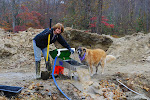
 Nearby we found the entrance to Crissan Mine. It is a working gold mine but like many a mine now that the big strikes have been worked out, this one "mines tourists" for a greater return than the mine could otherwise produce in mineral content alone. A tour is a couple bucks. Panning or running the trommel, a couple bucks. A bag of sand with gold concentrates, a couple bucks. Being a new age gold miner- priceless.
 Crissan boasts the only operating "Stamper" in the state. If you are not familiar with the term "Stamper", it is a shaft driven machine for smashing, grinding, pulverizing quartz into sand. Because the gold at this mine is contained within the quartz, breaking it down into sand makes it possible to reclaim the gold as it is released from its host. Big rocks in- course sand out. About a quarter oz. of gold per tom of rock crushed. A most amazing process. Gold concentrates sold at the mine are produced in full (sand and gold) from the on site process of the mine.
 There's plenty of the old equipment to see and it's in great shape. While we love seeing the types of machinery and equipment that was used in the earlier mining efforts, we always love to see present day equipment too and Crissan mine has a store that sells all types of modern day pieces for today's prospectors- pans, sluices, high bankers, dredges, and so on. We picked up and added a small highbanker/dredge combo to our on the road arsenal.
 Almost every shop in town can sell you a gold miner's hat. Not a necessary piece for those seeking "placer" gold- that gold that has already been released from the earth by erosion of one type or another- but colorful and great fun for the kids.
 We stopped by, but didn't have time for the tour, at the Consolidated Mine nearby as well. The operation here is more tour oriented and goes under ground, but they do have panning facilities and you can pick through their "seeded" bags of sand for gems and crystals as well as gold. We will take the under ground tour at some point, but for authenticity of operation, display, quality sales and actual on site operation- Crissan Mine is a much better way to spend some time.
 The gem sluice table at Consolidated Mine is pictured below...
 After a couple of days exploring Dahlonega from our base camp on the Etowa River, we drove an hour or so to Loud Mine, Cleveland, Georgia. This "gold claim" is the property of the Lost Dutchman Mining Association. Formerly a separate group but closely affiliated with GPAA which we have mentioned many times in the past, the LDMA and GPAA are now commonly owned by the enterprising son of Buzzard Massey, founder of the recreational gold prospecting activities as we know them today and also the creator of the Outdoor Channel, which most if not all of you are probably familiar. Tom Massey and his wife and family now run both operations, and we came to attend an LDMA common outing at the invitaion of the LDMA to GPAA members, which we have been for some time.
While GPAA owns, operates, and leases "gold claims" for use by its members, The LDMA takes the operation one step further and makes their claims available for members to prospect and camp. While the camps are "rustic" to "primitive", they each have their own distinct features and beauty and members are permitted to stay, even long term, to camp, prospect, and enjoy the area surrounding each camp. A few "hookup" sites are available at some of the camps but dry camping is more the order of the day. We found the Loud Mine property in Cleveland, GA to be just delightful. Sign us up!
 Nearly 200 people attended this rally, with about 125 of us joining in a common operation. We split up into teams, each team running a highbanker. We learned to set them up correctly, make adjustments, and got a look at about 6 different makes and models. It was a good intro to help with making a selection for those of us who might like to acquire a piece of equipment for ourselves. Water for the highbankers, this is a "wet" operation as opposed to a "dry" operation that might be used on the desert, was supplied by a series of pumps run to the stream. Water from the process (which does create some silt) is released into settling ponds so that the silt is not returned in any significant amount whatsoever into the river. Members may use their own machines in the area of the settling ponds by recycling that water for their purpose. The whole operation seemd to be set up quite safely as it regards concern for the environment. Properly carried out, recreational mining is actually quite good for the environment. Dangerous chemicals used in the past are no longer necessary with today's methodologies, and sound digging and dredging techniques actually and significantly improve fish and other wildlife habitat. Good organizations "self police" their members. This one does!

For those who preferred not to engage in the common operation, there was plenty of places to get off by yourself or in a group to enjoy the outdoors and see what you might turn up in your pan.
 Our highbanking team was made of of a dozen workers or so. We could not have been happier to be hooked up with any other of the teams. Nice people. Interesting people from a wide variety of backgrounds. Fascinating experiences and tales to tell. AND, they all worked harder and more effectively that I saw any other group working - hands down! While working efficiently is a matter of control, there is also no escaping the fact that moving material is the key to finding the gold you are after. Luck aside, it's pretty much a no pain, no gain story. So while other teams put dirt in the hopper and let the machine do the work, I would say we effectively quadrupled the amout of yardage we ran through our machine by making sure every team member had a job. We shoveled into buckets. We lugged buckets. We added water and slurried the material by hand befor feeding it through the highbanker. Georgia clay is think and tough and nasty- so it must be effectively broken up (make that down) in order to release its gold, and also to avoid a clump that could pick the gold back up and carry it off the end of the machine where it would most certainly be lost. We adjusted water supply. We pushed big rocks out of the way. We kept our drainage channel open. We truly worked as a team and that was a good feeling.
Now Georgia produces some pickers and some nuggets (although mostly "fines"), but because of how effectively we worked and how much material we processed, we manged to come up with the largest nugget found on the property in at least a couple years. That's what one of the crew members told me. However LDMA roving rep Ken Rucker told us he thought it might be the biggest one from this property in an even longer time frame than that. To be sure, landing that big one was a group effort, but it just did happen to be me who saw it in the sluice bed and picked it out to go show off to the team. Not your typical nugget, this looked like (and was quickly named) the "Flying Eagle" nugget. Word of its discovery spread through camp faster than the 49ers headed off to California!
Because it was a common operation, all of the gold was distributed by means of a lottery so the nugget did not wind up in the hands of any of our team liked I had hoped it would. But seeing it flash in the sluice, picking it out of the water and looking at it in wonder was worth the effort in ways I can't really explain. It was a moment, of which there all too few in this life, that I am sure will stick in my head til I draw my last breath. It was a moment I think is shared by most if not all of the members of that team. In the greater scheme of life it was a relatively small piece of gold- but oh what a moment!
 But lest you think it is all work and no play at LDMA- think again. I got more tired trying to catch all the planned events than I did in working my assigned shifts. I think the constant laughter wore me down a bit as well. Interesting thing about the activity of prospecting- it brings together people of all ages, all backgrounds, and all physical abilities as well. No matter- everyone had something to do and found a way to get it done. And they found a way to have fun doing it. Those confined to scooters- on your mark, set, hey he's cheating, go!
 Ah, camp. All the necessities. Antenna- it's for the Outdoor Channel, don't you know. Gotta have a couple crappers for those not self contained, right? A resident constable, who shows off that he was able to recover the plastic cup and Christmas light chandelier that had gone missing in the "whodunnit." Not to worry, that rascal was found guilty and sentenced in Miners' Court a short time later. Go get'um, Dave.
 You want to know how far we went to recover all the gold in our team's material. We had our own "stamping" operation going full time on site. Any good looking piece of quartz that came our way got crushed to release whatever fines we could find...
 Here's the team. I used to think the one thing "miners" had in common was that they liked "getting dirty." Apparently, the truth is that they like playing in dirt; I however, evidently really like getting dirty. Truth is, some of the tasks in the process require getting dirty, some getting wet, and some times you get a job that lets you stay clean- but who wants that job???
 At the start of this contest, the "Detectives" must keep metal detectors up until the start command is given. A series of tokens are placed and/or buried and the winner is determined by who finds what in a given time period. A good time was had by all.
 Can't you just tell the look on the face of someone who just found "sumpin good" ?
 Pot luck suppers are a regular part of the rallies. There was some pretty good grub on that table.
 And in the end, here's the gold that was split up among the participants in the common operation. Volunteer crew members, very necessary to the process, get a share of the loot as well. The "Flying Eagle" is in the vile in the center of the pan along with some of the other pickers that came out of the common operation.
"Hey, Greg!(No. Not me.) Nice hat!" A Loud Mine tradition that surely was imported from Alaska one way or another. But I ain't talkin'......