Thursday, June 7, 2007

Fun With Fairbanks


Nearly a week has come and gone since we arrived in Fairbanks and I took the time away from “playing” to sit down and write. Ok. I DO feel guilty about it, but get over it. With so much to explore and 20 hours or more of light per day to do it, it is easy to get caught up in things and just keep going. That in and of itself has become something to learn to manage. And the problem, if you think of it as that, will only get worse in the short term as within the next two weeks we will have the much fabled 24 hours of actual sunlight per day. Stats for this day: sunrise 3:16 AM, sunset 12:22 PM. Everglades Sandy wrote to warn of artic “running amuck.” Don’t know if there is any truth to the origin of that expression being routed in the Alaskan time zone and the length of the day and the thawing of the top layers above the permafrost into “muck“, but the coincidence is a tad humorous even if not. I suppose this would compare to the winter months when there is at most three hours of twilight when Alaskans run around in “mukluks.” But it makes for an interesting consideration.

We did a lot in Fairbanks- way too much to try and capture it all. Now that I’m feeling a bit more acclimated, and won’t need to change time zones or daytime activities for the next several months, I hope to do a better job of keeping up with the duties of the blog. Some of you do get hostile the minute I stop writing, now don’t you???

We landed back in the mountains this day about 20 miles plus or minus from Denali. Good to be back in the mountain scenery zone. Fairbanks was basically mountainous but not so it was a matter of awe like the rest of the Alaskan Range. And perhaps part of the flattening of Fairbanks is owed in part to the use of water canons that literally chopped down some of the landscape as the gold miners washed off the overburden on their way down to the gold which lay on top of the bedrock layer beneath. You can’t drive anywhere, and I do mean anywhere, around Fairbanks without seeing huge rock tailings, the left overs from the gold rush and the processes that came with it. It makes for a very unique landscape in its own right and we enjoyed living the history lesson.

Some things of note from the week: We continued our “on our own” prospecting program, hitting various places around the city, some out as far as 70 miles or more into the boonies, where the animals of interest surely out-populate humanity by a landslide- a good thing to be sure. The Alaskan Public Land Use Office was good enough to help us locate some places to try. Two notable locations were the Nome Creek and the Felix Pedro claim. Thick ice still covered the ground adjacent to much of the stream. That made for some mighty cold panning and sluicing and such, but beautiful none-the-less, and we had the company of moose and porcupines to make us feel much better about finding such small amounts of gold. Still, any gold is good gold and we always manage to find a little.


I’ve never been one for cruises of any kind. I don’t mind herds of animals but I don’t much care for herds of people and that’s how cruises hit me. But Marilyn had read a lot about the Discovery Paddle wheel cruise on the Chena and had her heart set on going, so we reached a consensus agreement to hit the water. What a great call on her part! Best tour of any kind I think I have ever been on in my life. Loved every minute of it! The concept behind the cruise is to put passengers on a historic old paddle wheel boat and head out of the port of Fairbanks and on down the Chena River toward the Tanana River. The Chena River is deep, but not wide, which makes for a cozy little cruise which keeps you in close contact both with the shore line and what’s along that shoreline. This is not just a boat ride! Every so often, the ship stops mid stream and real live people and the enterprises along the river they represent come out and speak with passengers on the ship- from the banks of the river. They are rigged with microphones tied into the ships PA system, so listening is both easy and personal. The ship’s proximity to the shoreline makes the process work especially well. Some of the stops included visits with a bush pilot who landed and took off in his plane immediately alongside the ship with pontoons on his super cub. He later showed up down river and landed on a sand bar with another plane to show how versatile the flying residents and outfitters of Alaska can be. Excellent experience. We also stopped at the kennels of the late, great musher Susan Butcher. Susan was four time winner of the Iditarod dog sled race and is the ONLY human being ever to mush a sled to the top of Mt McKinley (Denali) - a feat I simply cannot understand is even possible. She is almost a god here and her kennel, with over a hundred dogs still operates along the river where she lived. Her family and associates run the kennel and are quite amazing in their own right. We had a demo with a team of dogs pulling the ATV at speeds of 18 MPH along the river.
Also visited with a herd of Caribou in full regalia which finally provided an opportunity for a good photo or two of the elusive "reindeer.” I am sure you can appreciate how hard it is to get a good shot of them; after all, how many years have you been staying up late December 24 trying to sneak a peak at Rudolph? And we loved the Eskimo/ Athabascan village at the end of the downriver run. There we saw a real fishing village complete with salmon wheel and fish being cleaned, dried, and smoked along the banks. Met some “first nation” members of several “villages” (or tribes) and saw first hand leather and fur processing and sewing, and what life is still like in many of the villages today. And at this point, we disembarked the ship and strolled into the village and met with each party that had “met” us along the cruise for Q & A, and up close and personal interaction. A well planned, authentic, fascinating look at Alaskan life that, taken contact by contact, would have been difficult or impossible to arrange in the amount of time we had. A bargain by any standard.


This Athabaskan made fur jacket is modeled by an Eskimo girl. 16,000.00 for the jacket if you're interested. I wanted to pick one up for Marilyn but she thought it might be a bit much back at poolside in Cape Coral, Florida.
"Dog" salmon being dried on an open smoke pit along the Chena River. This salmon is processed especially for the sled dogs. Sun dried and lightly smoked...


You can’t (well, you can, but you really shouldn’t) visit Alaska without taking a look at the oil pipeline from Prudhoe Bay on the Arctic Sea to Valdez. Sure enough, there is a site especially geared for viewing the 800 mile marvel just outside of Fairbanks to the north. It seemed smaller than I expected at an interior diameter of only 48 inches but as long as it keeps moving the good stuff along I guess that doesn’t worry me too much. The pipeline is half underground where it can safely be buried in bedrock and half on pilings, where it must be kept insulated and above the constantly shifting permafrost. Where it is on pilings, it is supported by Teflon sleds to allow for earthquakes. I got a big kick out of the fact that, upon close inspection, each sled at the viewing site was “held together” with duct tape! Now of course that’s not really the case- the tape holds on rubber piping insulation so that tourists who insist on getting too close for a photo don’t crack their heads on the relatively sharp iron braces. Still, I thought it should be the shot of the day. Duct tape, the official state tool of Maine in use right here on the Great Alaskan Pipeline.


Look for the duct tape holding the Alaska pipeline together (not really).

Tour all the gold mines we could find, we did! All sizes and shapes, they were. Fascinating, they were. One, the El Dorado Mine, was run by the same concessionaires as the Discovery Cruise and was an excellent learning and hands on experience. One at Gold Dredge #8 was privately held and poorly run but still permitted us to see processes and equipment we might not otherwise have seen. Given a choice between one tour or the other when in Fairbanks- go see our friend Yukon Yonda at El Dorado Mine. She and her husband have been working the gold fields here for 30 years and are not only thoroughly amusing, they are wells of experience and knowledge and they are anxious to share their expertise. And as Yonda tells all the husbands touring the mining operation, “You might as well turn over any gold you find to your wife right away; after all, you gotta go to sleep some time!” Yonda’s motto: Gold? Mine!!!

Yukon Yonda, in blue above and below, discusses and demonstrates finding real gold. Don't touch her gold with wet fingers! It's where the term "sticky fingers" comes from; touch wet gold and it sticks to your fingers. Mine workers in charge of gathering the fine gold from the cleanups became known as the "sticky fingers" because they always had gold sticking to their hands. It later became a negative term associated with swiping the goodies.
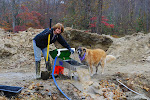
This sluice worker panned out a sampling from the run we watched. The small gold is still in his pan, but there was one really nice nugget he put in his mouth for safe keeping. The sound a nugget that size makes hitting a metal pan is lovely music to the ear!

They let Marilyn hold it! It took Yukon Yonda and three big burly miner guys to get her to put it back though! (just kidding)


Wooden bowls, burl and otherwise are everywhere in Alaska. We took an hour and visited the Great Alaskan Bowl Factory. This wood shop produces high end wooden bowls and other products all made out of one of my favorite woods, white birch. Not an easy photo shoot, the visit was interesting and we got to see both tools and products we had never seen before.


Parting Shot: Wherever we can, we visit farmers markets. They are usually operated by people closest to the earth in their chosen location and thus provide a direct view past all the hoopla of tourism and into the soul of the locals. This far north, it was way too early to have the farmers market in full swing. Most of the items were crafty in nature and the vegetables typical to this locale were seedlings for sale rather than fully grown produce from the harvest. A few more adventurous growers did have some hot house grown cucumbers and cherry tomatoes, but there wasn’t much else. Later in the season we hope to see the state fair with its hundred pound cabbages and world class strawberries and the like. It may be a short growing season, but with round the clock light from the endless day, things have a way of catching up real fast. One photo to represent it all- bright red radishes and little tiny crocheted “mukluks.”

Friday, June 1, 2007

Odds and Ends

Here's a bunch of "odds" and "ends" from along the last couple day's travel in the land of Alaska, which, by the way has its very own Time Zone. Alaska is 4 hours earlier than Eastern Time, in case you're interested.
In this photo, the Alaska Range "Greater Mountains" showed off the end of the range in fine style. While it may be a bit grainy owing to the use of a digital zoom to get me to the top of the mountain, you can see that there is still plenty of snow up there. With every mountain range along the journey, we kept saying to each other, "It can't get any better than this." But then it did!
The Alaska Highway ends at Delta Junction, just south of Fairbanks, where we will now honker down for a week or so to take in the sights before getting back on the move. We are here ahead of the salmon, which have not yet begun their "run,"so there is no hurry to get anywhere, although, I am getting a bit antsy about getting going on the fishing aspect of the trip. We arrived in Fairbanks officially on May 31- some 3 to 5 days earlier than we thought we would arrive; this fact attributable to the lack of problems and delays, the allowances for which were built into the trip. Those RV's wearing cardboard "Alaska or Bust" signs in their windows have all burned them at the campfires over the last few nights. We didn't have the sign, but share in the joy of the ritual. The odometer rolled over 14,000 miles today. Some trip. Here, I'm waving the flag of Alaska in a brisk wind at the marker. The flag shows the big dipper and the north star. How appropriate.
This oddity is a burl mosquito (and then a caribou). Obviously those little buggers ARE as big as they say, though they have not been a bother at this point. Burls are big business in Alaska. Growths produced by trees to fight infection and infestation, they are often used to make bowls, sculpture, walking sticks and the like. Some of the pieces are quite pricey; all are quite beautiful. And very heavy ...or I would have loaded up the coach by now.

Alaska is well known for its scenery, its culture, its hunting and fishing. But PIG trapping? Yes, that too. This is a "pipeline pig" used to clean the inside of the Alaska oil pipeline from time to time. It is "sent in" from a starting station, then recaptured and itself cleaned in a designated "trap" along the way. Some pigs just clean; some pigs take microscopically fine measurements of pipe wall thicknesses, temperature variations along the way, and are capable of finding trouble areas before the trouble gets out of hand. At least that's the theory. Neat instrument.
This shot is NOT out of focus and was not taken on a foggy day. This is a sandstorm blowing off the basin of the Tanana River. The river bed is much wider than the current water level is covering. Without water to keep it wet down, it becomes much like a desert. Interesting; almost eerie.
This is the Ptarmigan, state bird of Alaska. A popular bird and quite pretty to look at, the name is hard to remember for some and difficult to spell for everyone- so the bird is just called "chicken." The bird gave it's name to Chicken, Alaska -rural, remote gold country in an area of the state where not all the roads are paved and some means of getting to the town require a ferry ride for the rig. We, that is to say I, was not brave enough to tackle that on our first trip here. I guess you could say I was "chicken" too!
This is the end of the Roberson Glacier, referred to as the terminus. Where it ends, the Robertson River begins and eventually flows into the Tanana 33 miles downstream. Photo taken from a bridge in a moving coach- there is a lot to see in Alaska for which you simply cannot stop your vehicle, either because there is no time to stop or there is no room to get off the road or, in the case of wildlife, they are gone before you can ready the camera. Which, come to think of it, is why we have still not shown you moose, golden and bald eagles, foxes, snowshoe rabbits, ground squirrels, minks and a whole lot more....
But while this post represents the end of the "rush" to Alaska, it also marks the beginning of our summer here. Surely there is much more to come in this land of majesty, mystery, and marvel.

Midnight At The Oasis

This shot was taken a half hour after midnight! It's not exactly "midnight sun" at this point yet, but, as you can see, it is still plenty light and very nice for working late and looking out the window, going for a late night stroll, whatever. It becomes very easy to stay up later, do more things in a day, sleep a little less. The absence of the dark of night seems easy on the body and the mind- peaceful, restful. The locale of the shot was TOK. No flash or remote lighting was used. It got dark, or should I say as dark as it gets, about 1:00AM; then two hours after that it gets light all over again.

Thursday, May 31, 2007

Frost Heave The Snowman

The mountains stayed with us again from Destruction Bay to Alcan to Tok (pronounced as though it rhymes with “joke“). We have just barely scratched the surface but already Alaska feels like a most amazing place.

A word or two about the road conditions of the Great Alaska Highway! The last two travel days we have experienced the gravel stretches, the frost heaves, the pot holes, the cracks that everyone warns you about right before they swear that the trip will destroy your vehicle, rupture every one of your tires and just generally make life miserable. Yes, there are a few generally poor spots that you could say that about, but all things being equal, the entire length that we have traveled to get here was incredibly excellent. We did NOT, knock on wood, have a flat tire, nor did we see anyone along the way who did. We did NOT have the vehicle destroyed, nor did we speak with anyone along the way who did. And we can now report that if every highway in the US and in Canada was as good as this highway is, the world would be a better place - and I would have back the hub cap I lost on Rt. 10 in Texas and the 48 bucks it took to replace it! For the most part, to spell it out, the highway is excellent, and all rumor to the contrary is a conscious plot on the part of residents to protect the state from over-population as regards tourists, gold miners, and new residents. We used to play the same routine back in Maine, telling tourists that “You can’t get there from here.“ Could you get a flat tire on the Alaska Highway? Yes. The odds that you will are about the same as they are for getting one anywhere else. Actually, they are probably a bit slimmer because you have heard so much negativity about the conditions that you make the trip on new rubber to begin with…. One word about appropriate speeds: 40 mph on poorer sections, 20 miles an hour where frost heaves are marked (and they are all marked well) and 10 miles an hour on the “washboards”- those loose gravel areas that have formed “ripples” for lack of a better word. Failure to observe the 10 mph speed recommendation for “washboard areas” will result in both bladder failure and loosened fillings.

Getting back to Maine for a minute, my old pal Chuck Kruger, singer, songwriter, performer, and big league talent booking agent, touched my life through his music in ways I will never be able to adequately share with others. Basically, we share a love both for Maine and the Caribbean- we are both “tugged” between the two and have spent significant parts of our lives in both places. Which is why I was so delighted to make the acquaintance of Alaska singer, songwriter, performer, Dave Stancliff at the general store in Tok soon after arrival here. We got to talking- one thing led to another- and before he left with his sidekick and his milkshake he had gifted us with a couple of his Alaska music cd’s. We hustled them back to the coach and popped them in the stereo for a listen- good stuff! Now I am not a guy who ever intends to equate someone to Kruger- he’s tops with me, but there was an interesting “Alaska counterpart thing” going on with Stancliff, and you might enjoy checking out his website and listening to a few sample cuts you will find there. For sure he will not mind if you send for a cd or two- they are excellent. So what’cha think Chuck, a Maine to Alaska promotional tour someday?

Monday, May 28, 2007

By Polar

I Love my little word jokes, especially when they are in the "post" titles, but let's get this out of the way right up front: this is a NON polar ice field we have been traveling beside (By) all day, not Polar. Still, at our campground of this day, the top two feet of soil is not quite thawed enough so that water and sewer are operable yet- a few days away perhaps. But the next 40 feet or so of perma frost is staying right where it is- no mater which global is warming! Destruction Bay of Lake Kluane is mostly frozen over. But around the edge and at places 20 to 50 feet out from shore, are the tell tale crystal clear chards that announce the ice out process is in full swing. There is nothing prettier in the world than the edge of a glacial lake at ice out- crystal clear, deep blue water falling to the depths that the eye wants to, but cannot, see into; chards of clear ice, floating ice daggers that twinkle and tinkle like wind chimes in the crisp air that still blows across the lake to hasten the process. Cracks in the ice remind of the glaciers coming and going of old, promising that fish are lurking just below and ravenous to attack the anglers first offering of the new and fresh season of combat. Such is the precipice of anticipation for me as I prepare mentally to enter Alaska proper on the 'morrow and fulfill the dream of a lifetime.

Let's talk stats: the ice fields in the pictures below are more than a mere snow capped mountain, which, by any standards is beautiful in its own right. But the icy fingers you see in these photos are glacial ice flows dating back 20 thousand years plus or minus and are...GET THIS!...2200 feet deep. If you did not previously get what I was saying when I told you the camera, the photo, and I could not capture the moment- perhaps this will help.

Perspective: The campground is gravel, not really even open yet, and ugly by many standards of beauty in and of itself. But would you spend 25$ Canadian though, to be cradled in the arms of ice fields and mountains, rivers and lakes, dating back tens of thousands of years- the beauty and awe of which is unquestionable if you can just look passed the gravel of the vacant camp site next to you. Problem answering that rhetorical question? Would you pay that amount if it included filling your fresh water tank, which is running on empty, from the owner's house hose? And if he let you tap into his wifi connection gratis, would that make it worth the price of admission. The answer, for those of us who have now traveled this route is a resounding, " Hell yea!"
Tonight I think I will sleep with the window shades open. Mountains in a 360 degree circle for the last thing I see before I fall asleep. Water filling the 180 degree view. Light not fading until close to midnight. And light reappearing three hours later. No one here other than me and mine to complicate the issue. Yukon, yes, but sweet dreams of Alaska....


Sunday, May 27, 2007

A Ladder Runs Through It

Back in Whitehorse, once again on our way NORTH to Alaska, and in the capitol of the Yukon, and a thoroughly modern city, a ladder runs through it. Technically, of course, a river runs through it and the ladder runs "around" it- the dam above the Whitehorse rapids and below the hydro-electric dam, that is. This is the largest wooden fish (salmon) ladder in the world, which is as it should be. This is also one of the longest salmon migration routes in the world as well. We were about a week before the first salmon run, so the ladder was not quite yet in operation. When we come back through in the fall, we'll have another visit and see if there are any fish going through. In addition to the Chinooks (aka King Salmon), Grayling and Trout also make use of the ladder and may be seen at the glass viewing station about halfway up the ladder.

SOUTH To Alaska...Huh?

In a course correction brought about by things we learned about summer scheduling in local communities, we decided to move the end of the trip up to the beginning…and headed south to Skagway on the coast rather than seeing it in the Fall on the way out of Alaska. Glad we did. It put Alaska on our map of visited states a few days earlier than we expected to have it and it was a spectacular intro to Alaska.
From the Yukon, through a strip of British Columbia, the road to Skagway is breathtaking both in terms of beautiful and unusual scenery, and in the literal sense, as the 11 mile decline from the mountains into the harbor town is 11 miles of 11% vertical drop- the steepest decline on any of the major Alaskan roads. It was a constant question whether to marvel at the vistas and breath with excitement or hold your breath for fear the coach would run away and send you into the abyss. There are two “runaway truck” ramps along the downward path that are supposed to stop you if the brakes fail. Personally, I think they would just launch you further out into the canyon, but fortunately I didn’t need to find out. For the trip back up the hill we have dumped our holding tanks of as much water and fluids as possible and lightened the load where-ever possible. Even a 400 HP engine will be tested climbing back to the top.
The customs agent coming “back” into the states had a sense of humor. How rare is that?
“Is this rig yours?
“Yes, sir.”
“Huh. Too bad. You deserve better.”
With that, we did the usual questions about what we do and don’t have and what we will and won’t do on this trip.
“Do you have any Canadian beef?”
“No sir, just some buffalo burgers from Montana.”
“That’s good. Because Canadian beef is just nasty. And speaking of that, while you’re in Skagway, be sure to order the fish because even down there the beef is all old enough to vote!”
Skagway is a nifty little village completely surrounded by mountains that afford it great protection in many ways from the weather, so the salt water keeps it more temperate than other places in Alaska in the winter. Still, a look at the snow thrower that mounts to the front of the train that descends into the village from Whitehorse speaks volumes about what temperate actually means in the greater scheme of things. It’s also a resourceful place. Reminded me, in that sense alone, of life on Roatan, where, objects found on the beach washed in by the tide, were not junk at all, but raw materials for anything you could figure out what to do with them. The facade of the visitor’s center is completely covered with drift wood. I actually found a nice piece myself to use as a walking/bear beating stick, and one store we walked into wanted to have their carver come out and do an Eagle head on the top of it right there and then.
“What kind of wood is that?”
“Oh, I don’t know; I call it “drift””
I bought my much anticipated Alaska fishing license in the local hardware store, where, I am reasonably certain, I was the first person ever to do so and then insist on a photo of the occasion. Hey! You wait 50 years for something, you should make a note of it when it finally happens.
We posted a picture of Emerald Lake which is on the road in. As is true of so much we are seeing and experiencing the picture refused to capture the glory of the color of the lake, but hopefully it will provide a glimpse into that amazing color for which it is named. Marilyn said that one lake alone made the trip worth doing; we just stared at it in amazement before continuing on. It left us with one of those images you store in your mind that never goes away- it was just that special a place.


Wednesday, May 23, 2007

Unpaid Advertisement!

In the Yukon Territory, there are three, not two, things that are certain. Death. Taxes. And Dings in your windshield!
New friends from the road traveling now behind us, and friends who know they will be passing by this way at some time: TAKE A NOTE!
The locals call him The Glass Doctor, but the yellow pages call him Glass Magnum. We saw his sign headed into the town of Whitehorse. George Sahlstrom, working neat as a pin in a white shirt and a surgeon's apron, is gainfully self employed doing "highest quality in all forms of glass repair." Plain and simple, he's a windshield man. The rest can call him what they like, but after he put a perfect fix on a mega bullseye with a crack starting to run in our front windshield today, we now think of him as "The Surgeon of Silicon." A more pleasant guy you are never going to find. I had asked for a referral at the fuel stop, then again at an RV repair shop near the campsite, and yet again at the campsite. Everyone said, "Call George." There was just cause: he is a master of the process and a hole I wasn't too sure could be fixed at all is now virtually invisible. How sure is George that the repair will last? He offers a two year guarantee on the job. With the wink of an eye and a pleasing grin he adds, "Two years...or two miles, whichever comes first." (George emailed after I posted this to add a "ha! ha! after the "2 mile gag" - I've no doubt his guarantee is every bit as good as the quality of his work...which is simply excellent)
And like all good doctors, dentists and surgeons, George is blessed with a wonderful "coach-side manner." As he started to drill out the ding for repair, he glanced at me over his shoulder and said, "Now let me know if this hurts...."
All of you headed to Alaska: You will require glass services! You DO want George to take care of you. He took our biggest ding to date and "healed it" without even the "scar" left by our other trips to the windshield clinic. Thanks Doc!

George Sahlstrom, Glass Magnum, Glass Doctor, Surgeon of Silicon makes a nasty ding in the windshield just plain go away. Note Marilyn inside supervising the job.

Jeremiah Was A Bullfrog

Jeremiah was a bullfrog;
was a good friend of mine...
Ah, but Rudolph was a Caribou,
Who knew?
Caribou, when domesticated and raised in such a herd- are REINDEER, making the famed Christmas Rudolph, the red-nosed caribou. This critter was NOT domesticated so he was a true caribou, and as a lot, they are skittish and spooky and don't hang around for a photo op ("now dash away, dash away, dash away all"), which is why this is the first image of one we have posted. We had cameras at the ready, traveling as slow as possible, and prepared to stop and jump out to capture at least one image, which is exactly what happened here. Gorgeous animal! Maybe not the best shot! But the best of the shots I got so it will have to do until I get a better one.